Category: ConTech

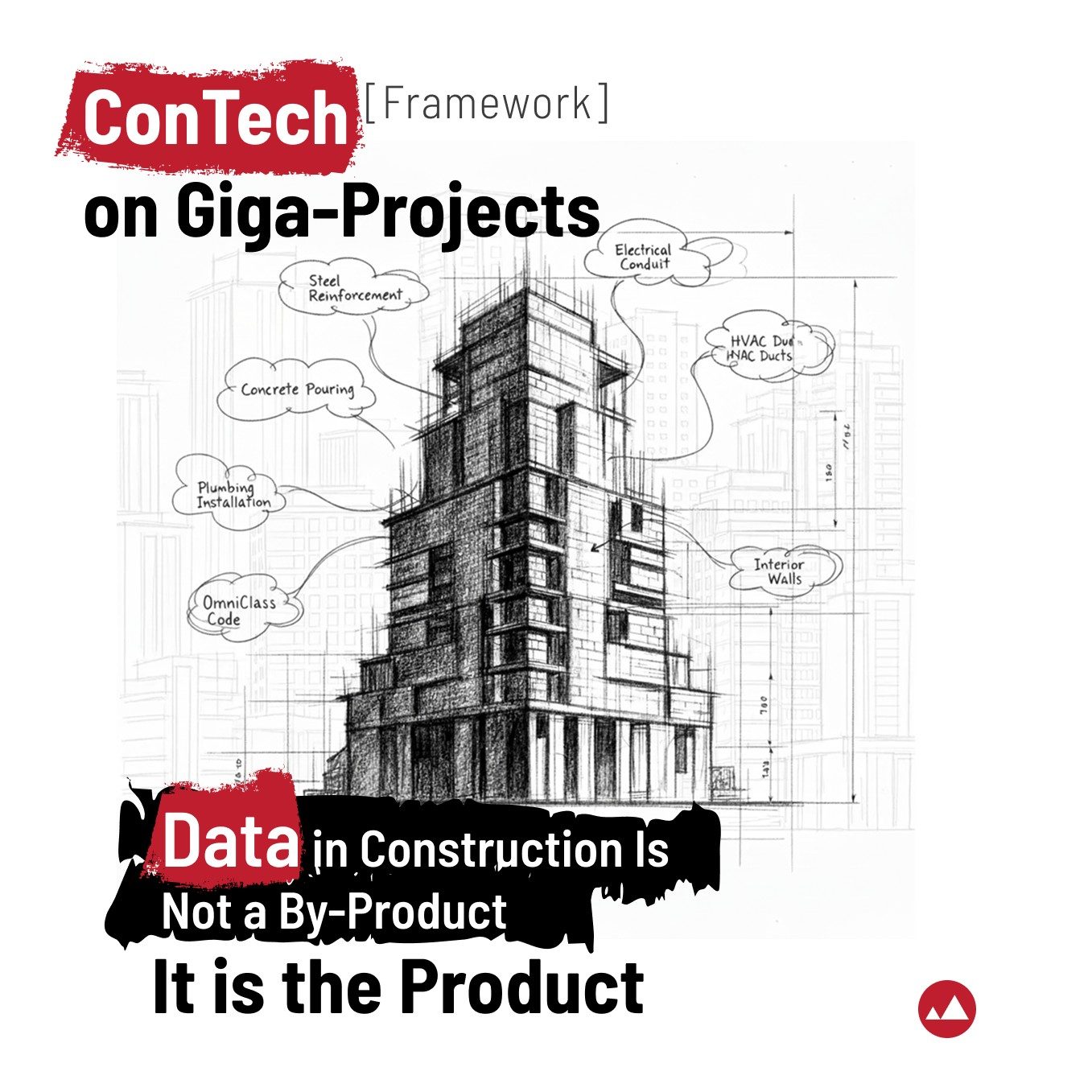
  • Data in Construction Is Not a By-Product — It Is the Product

    Data in Construction Is Not a By-Product — It Is the Product

    Data in Construction Is Not a By-Product — It is the Product

    Data in AEC Cover

    For decades, the construction industry has treated data as something that falls out of delivery.

    Executive Overview

    For decades, the construction industry has treated data as something that falls out of delivery.

    Drawings generate models.
    Models generate schedules.
    Schedules generate reports.
    Reports are archived, forgotten, or manually re-created.

    This mindset is one of the core reasons why digital transformation in AEC so often underdelivers.

    The uncomfortable truth is this:

    In modern capital programs, the physical asset is only half the product.
    The other half is structured, reliable, reusable data.

    When data is poorly defined, inconsistently structured, or misunderstood across the supply chain, even the most advanced digital platforms fail to deliver value.

    This results in hiring heaps of resources and assigning thm to already expensive platforms. Their role? Sift rough data and information deliverables.

    This is unarguably through for those who create information and those who pay for it,

    Resouces to ensure that platforms which were originally procured to solve this problem are actually working in the first place.

    To understand why, we need to look at data from every stakeholder’s perspective — and why each one struggles with it in different ways.

    1. The Asset Owner’s Perspective: Data as a Long-Term Liability or Advantage

    From an owner’s perspective, data has a uniquely long life.

    Buildings, infrastructure, and attractions may take 3–7 years to design and construct — but they operate for 30, 40, or 50+ years.

    Yet most owners inherit asset data that is:

    • Incomplete & Inconsistent
    • Tool-specific
    • Poorly structured
    • Difficult to migrate

    The root cause is rarely technology.
    It is almost always unclear intent.

    Owners often ask for:

    • “BIM”
    • “Digital Twins”
    • “Asset registers”

    …but struggle to define:

    • What data actually matters
    • At what level of granularity
    • In what structure
    • For which operational use cases
    • At which stage of asset design or delivery

    Without this clarity, asset data becomes an operational liability:

    • CMMS systems require manual data re-entry
    • CAFM integrations stall
    • Digital twins never move beyond visualization
    • AI initiatives lack reliable inputs

    For owners, the strategic shift is this:

    Stop thinking of data as documentation.
    Start defining data as a long-term operational product, that benefits your project delivery today.

    This is where Asset Information Requirements, structured coding systems, and lifecycle-driven data definitions become critical — not as compliance documents, but as business enablers.

    2. The Consultant’s Perspective: Data as a Deliverable, Not a System

    Consultants sit at the intersection of intent and execution.

    They are expected to:

    • Interpret owner requirements
    • Translate them into models, drawings, and reports
    • Coordinate across disciplines
    • Deliver within compressed timelines

    The challenge is that consultants are often asked to deliver data without a stable data model.

    For example, on a multi-billion dollar program or a portfolio of assets, each design consultant chooses to define their own room numbering and naming system, (the Owner has not explicitly defined such nomenclature – upfront).

    This results in rework downstream, or even worse: crippled maintenance and asset management system. Both of these ourcomes are costly.

    In these kinds of situations common pain points include:

    • Vague or contradictory information requirements,
    • Late changes to the scope,
    • Misalignment between classification systems, and most importantly why we need one,
    • Unclear distinction parent/child hierarchy of assets, systems and equipment,
    • Data requirements that are disconnected from actual downstream use.

    As a result, data becomes:

    • Over-modeled
    • Under-structured
    • Repeated across multiple tools
    • Difficult to validate
    • Costly to maintain

    From a consultant’s perspective, data is often treated as:

    “Something we must include to satisfy contractual requirements.”

    Rather than:

    “A structured system that must survive multiple handovers.”

    The opportunity for consultants is significant:

    • Shift from file-based thinking to data-centric modeling
    • Advocate for clearer data dictionaries early
    • Align geometry, metadata, and classification coherently
    • Help owners understand the cost of ambiguity

    Consultants who master this shift move from being service providers to strategic digital advisors.

    3. The Contractor’s Perspective: Data as Risk, Overhead, or Burden

    Contractors are often unfairly blamed for poor data outcomes — yet they are frequently handed the least buildable information. Typically, the ask is to complete the design, coordinate it and make it buildable, technically for free.

    From a contractor’s viewpoint, data challenges usually appear as:

    • Models that were somehow pushed to meet the design intent and churn drawings out,
    • Absolute lack of primary coordination between different disciplines.

    The two point above render the design incomplete and create re-work. Re-work that is ultimately paid by the Owners/Clients via variation orders and other contractual instruments.

    In this environment, data is seen as:

    • Additional cost
    • Contractual risk
    • Administrative overhead
    • Something to “complete at the end”

    So technically and literally the very process and technology that was meant to help us deliver our project in a more efficient manner, becomes the additional heachace that follows the leading information mess. This is why asset data is so often:

    • Filled manually
    • Completed in spreadsheets
    • Detached from site processes
    • Re-created instead of validated

    Yet contractors are uniquely positioned to add high-value, high-fidelity data. And as a byproduct, the contractors in the GCC are uniquely positioned to digitally transform their entire businesses at a cost to the client.

    When data requirements are well-defined and tools are aligned, contractors can:

    • Capture data once
    • Validate it progressively
    • Link it directly to physical assets
    • Reduce handover friction
    • Protect margins

    The key shift is turning data from a handover burden into a progressive delivery asset. At no cost to the contactor, because guess what, the Clients/Owners today in the GCC are funding the digital transoformation of a whole ecosystem. Smart ones are benefitting from it, others are on their way to become fossil.

    4. The Software/Platform Vendor’s Perspective: Data Without Context

    Software and platform vendors face a different challenge. Most often than not, the challenge is really compatibility and flexiblity to cater for all possible scenarios, for multiple geographies and cultures. Adaptiblity to a multitude of ways of working.

    Most platforms are powerful.
    Most integrations are technically possible.
    Most vendors promise interoperability.

    Yet platforms are often deployed into environments where:

    • Data structures are undefined
    • Naming logic is inconsistent
    • Classifications are mixed
    • Asset identities are unstable
    • Governance is unclear

    As a result, platforms end up:

    • Mirroring chaos
    • Automating bad processes
    • Amplifying inconsistencies
    • Becoming shelfware

    From a vendor’s perspective, the industry often expects:

    “The software to fix the data problem.”

    But software can only process what inputs it is given. The most successful digital ecosystems emerge when:

    • INDUSTRY LED: Software vendors work closely with or employ insustry leaders,
    • LEAN DATA DRIVEN: The data that their platforms require is not superficial but rather practical,
    • CONFIGURABLE: Rigit capabilities are converted into felexible configurations,
    • EASY TO ADOPT: And last but not least, the software/platform implementation does not take an army to configure and deploy.

    This is where Common Data Environments, integrated schemas, and lifecycle-aligned data models make the difference between adoption and abandonment.

    5. Data as a Product: A Necessary Mental Shift

    Across all stakeholders, the fundamental issue is the same:

    Data is rarely treated as a product with users, lifecycle, and value.

    In a data-driven project environment one asks different questions:

    • Who will use this data?
    • When will they use it?
    • What decisions will it support?
    • How accurate does it need to be?
    • How will it evolve over time?
    • How will it be validated, governed, and retired?

    When applied to the built environment, this mindset leads naturally to:

    • Structured Asset Breakdown Structures
    • Stable instance-level identifiers
    • Clear separation between type and instance data
    • Consistent metadata schemas
    • Progressive validation workflows

    This is how Asset Information Models are born — not as a file set, but as a living data product that feeds:

    • CMMS and CAFM systems
    • Smart maintenance strategies
    • Digital twins
    • AI-driven insights
    • Future asset repurposing and optimization

    6. The Downstream Opportunity: Data That Outlives the Project

    Well-structured asset data enables more than operational readiness. It enables:

    • Portfolio-level benchmarking
    • Predictive maintenance
    • Energy optimization
    • Space utilization strategies
    • Retrofit planning
    • Repurposing of assets
    • Faster response to regulatory or operational change

    In this context, data becomes strategic infrastructure. And like any infrastructure, it must be:

    • Designed intentionally
    • Governed rigorously
    • Maintained consistently

    Closing Thought

    Adoption of ConTech does not struggle because the industry lacks tools.

    It struggles because:

    We have not collectively learned to design, govern, and value data as a product or a deliverable.

    Until that changes, BIM, digital twins, AI, and smart operations will remain underexploited promises rather than operational realities. The perceived significant positive impact on businessvalue is still to be realized.
  • Standards & Governance frameworks as catalysts | ConTech on Giga Project Series

    Standards & Governance frameworks as catalysts | ConTech on Giga Project Series

    ConTech on Giga Projects [Framework]| Standards & Governance frameworks as catalysts

    Standards Cover
    Digital Twin Strategy and Execution in KSA and UAE

    01| Executive Overview

    Across mega and giga projects, one pattern appears again and again:

    Projects invest millions in digital platforms — yet struggle with rework, delays, duplicated effort, and unusable data.

    Digital chaos is expensive — governance saves more money than software ever can.

    The root cause is rarely the technology.

    It is weak or inconsistent information governance.

    Construction Technology succeeds only when it is built on a clear, enforced, and shared governance framework — and globally, ISO-19650 provides the most reliable backbone for doing exactly that.

    That said, in my humble opinion, it is of paramount importance to master the standards, specifications and globally accepted best practive – however, it is even more critical to undestand and be driven by the business values of your organisation and project goals.

    One must master the standards well enough to break them deliberately in service of project and business outcomes.

    02| Why Governance Comes Before Technology

    Most digital failures don’t happen because teams lack tools.

    They happen because teams lack:

    • Clear responsibility
    • Structured approval paths
    • Consistent data ownership
    • Enforced information standards

    Without governance, technology amplifies chaos instead of eliminating it.

    ISO-19650 is not standard about BIM software or platforms.
    It is about how the asset information is created, managed, reviewed, approved, disseminated, across the entire lifecycle of a project.

    On mega projects, this distinction is critical.

    03| Model of Responsibility: Who Owns What — and When

    One of the most underestimated sources of digital failure is unclear responsibility. I have seen first hand, duplicate functions of similar or same function trying to push and pull data their own way. Nobody won, while for projects it was detrimental.

    It usually is a bad sign (or a red flag) if projects/organisations lack defintions of:

    Who authors information

    Who reviews it

    Who approves it

    Who ultimately owns it

    These typically result in:

    Conflicting models

    Unclear accountability

    Endless review cycles

    Risk transferred informally instead of contractually

    ConTech oviously becomes a burden rather than a solution

    A proper ISO-19650 based governance model establishes clear information roles across:

    • The Owner/Client (“Appointing party”)
    • The Lead Design Consultant, the General Contractor, etc. (“Lead appointed parties”)
    • Sub-Consultants and Sub-Contractors (“Task teams”)
    • Delivery stages

    When responsibility is clear, decisions move faster and disputes drop sharply.

    04| Approval Workflows: Information Is Only Valuable When It’s Trusted

    Uncontrolled information is worse than no information.

    Mega projects often suffer from:

    • Parallel approvals
    • Informal reviews outside the CDE
    • “Approved” files with no traceable audit trail
    • Design decisions made on outdated information

    I am not a big fan of standards – especially the terminology that comes with each new standard/edition.

    That said, ISO-19650-aligned approval workflows coupled with the right CDE platform ensures:

    Reliable source of truth/reference

    Documents that have a clear status (WIP, Draft, Approved, etc.)

    Traceable approval workflows

    Non-destructive, collaborative, real-time commenting and approval workflows

    Tracable version control and change substantiation

      We shall explore more on the verion control and non-destructive workflows on later chapters.

      05| Naming Conventions: Small Discipline, Massive Impact

      Here is a low-hanging fruit:

      Information management 101 — “If it’s a variable, then it has no place in your document numbering protocol – it must be stored as metadata”.

      Naming conventions are often treated as an administrative detail.

      In reality, they are foundational to automation, reporting, and data integrity.

      Without consistent naming:

      • Dashboards Lie
      • Finding the latest drawing or the model requires a full-time document cotroller
      • AI and data analytics related use cases become impossible

      ISO-19650 by itself does not offer naming protocols, there are other standards that do this better, including local and regional adaptations of ISO 19650 — it offers metadata discipline that then can lead you to a meaningul and informed file naming and numbering protocols.

      On large portfolios, consistent naming enables:

      Cross-project analytics & reporting

      Long-term asset data re-use, for internal and external stakeholders.

      Traceable approval workflows

      Scalable digital twin foundation

      06| Integrating WBS, LBS, and ABS: One Language Across the Project

      Governance fails when each team speaks a different “data language”

      True digital maturity requires alignment between:

      When these structures are disconnected:

      • Asset registers are rebuilt manually
      • Handover becomes spreadsheet-driven
      • Operations inherit unusable data

      ISO-19650 provides the framework to connect these structures — but projects must implement them intentionally and deviate from standards deliberately – where needed.

      Integrated coding is not optional on mega projects.
      It is the only way to scale information without collapse.

      07| Final Thought — The Hidden Cost of Inconsistent Governance

      The most dangerous aspect of poor governance is that its cost is rarely visible upfront.

      Instead, it appears as:

      By the time issues surface, millions have already been lost. The the only viable justification or the hope is:

      The power of the crowd will somehow push this to the finish line.

      Strong governance framework doesn’t slow projects down —
      it removes friction before it becomes expensive.

      Governance Framework Is the Real Digital Backbone

      Technology changes quickly. Governance endures.

      Projects that succeed digitally don’t chase tools — they stabilize their information backbone first, then let technology serve it.

      Stay Tuned

      These series are written from a project delivery experience – not theory.

      Over the last 20 years, I have helped deliver 30+ giga projects in UAE and KSA, totaling to over $20 Bn.

    • Why Mega Projects Need a Multi-Layer Information Architecture (and Why the CDE Is the Backbone)

      Why Mega Projects Need a Multi-Layer Information Architecture (and Why the CDE Is the Backbone)

      ConTech on Giga Projects [Framework]| The CDE Conundrum: This vs. That

      Digital Twin Strategy and Execution in KSA and UAE

      01| Executive Overview

      On mega construction programmes, complexity isn’t an exception — it’s the business as usual.

      Projects don’t struggle because of technology — projects do struggle because of fragmentation.

      • Multiple consultants.
      • Multiple contractors.
      • Multiple asset types.
      • Nested projecst that create complex interfaces (this one is from my unique experience)
      • Multiple stages running in parallel.
      • Stages that are contained in silos (a unique experience from my previous giga-projects and aperspective that should not have to exist)

      Yet most programmes still attempt to manage this complexity using isolated tools, disconnected data, and stage-based thinking.

      The result is predictable:
      rework, duplicated effort, delayed decisions, and painful handovers.

      The real challenge isn’t which software to use — it’s how information is structured, governed, and connected across the project lifecycle.

      02| The Myth of “One Model” — and Why It Breaks at Scale

      A common misconception is that a single federated model (or a single platform) can act as the source of truth for everything.

      In reality, mega projects don’t operate on a single layer of information. They operate on multiple concurrent layers, each serving a different purpose, audience, and time horizon.

      Trying to collapse all of that into one model creates:

      Bloated files

      Conflicting ownership

      Unclear accountability

      Fragile workflows

      What’s needed instead is a multi-layer information architecture, with clear boundaries and controlled interfaces between layers.

      Projects don’t struggle because of software. The struggle is caused by lack of alignment.

      03| The Multi-Layer CDE — Information by Purpose, Not by Tool

      In a mature construction technology framework, information is layered by intent (a.k.a. use case), not by software.

      At a high level, these layers typically include:

      Design intent & coordination

      Delivery, construction & field verification

      Commercial, planning & reporting

      Asset, equipment & operational data

      Portfolio-level governance and analytics

      Each of these use-cases evolve at a different pace, are authored by different parties, and consumed by different stakeholders (almost in parallel).

      The mistake is treating all layers as equal — or worse, unmanaged (un-structured, un-governed, ect.).

      04| The CDE Is Not a File Repository — It’s the Spine

      This is where many programm leads, and even senior leadership members get it wrong.

      A Common Data Environment (CDE) is often reduced to:

      “Where files are uploaded.”

      In reality, on mega projects, the CDE is:

      The system of record

      The workflow engine

      The governance layer

      The integration point between CAPEX and OPEX

      The beating pulse of the project

      When configured properly, the CDE doesn’t just store information — it enforces structure, controls states, tracks accountability, and preserves lineage from early design through to operations.

      Without a strong CDE strategy, every other digital initiative becomes fragile.

      05| Controlled Status Sets, Not Chaos — Why Status Matters More Than Files

      Where is the latest drawing of this floor and that discipline? — “I know a guy, who knows a guy, who own the latest version”.

      One of the most overlooked aspects of information management is state / status

      • Draft.
      • Shared.
      • Reviewed.
      • Approved.
      • Superseded.
      • Etc.

      On mega projects, unmanaged states of information and data are more dangerous than missing data.

      A well-designed CDE ensures that:

      • Information progresses through controlled states
      • Reviews are traceable
      • Changes are auditable
      • Decisions are defensible months or years later

      By the way this last one is a cheeky one, as many senior leaders intentionally avoid decision making, oftentimes blaming lack of reliable data. So a well structured CDE and a workflow engine may accidentally fix that!

      06| From Concept Designs to Delivery and then to Assets — The CDE as a Bridge, Not a Dead End

      Most projects treat handover as a finish line.

      Mega projects can’t afford that.

      In my 20 years of experience, there was no instance where asset information was readily available at the time of asset handover.

      In the modern world, a proprely configured and managed CDE must act as a bridge between delivery and operations, ensuring that:

      When this is done right, asset operations don’t “start from zero” — they inherit structured, validated information.

      07| Final Thought — Scale Demands Architecture, Not Just Tools

      Mega projects don’t scale by adding more platforms or more dashboards.

      They scale by:

      Construction technology only delivers value when it’s treated as infrastructure, not decoration.

      In the next post, I’ll dive deeper into how information requirements and data standards are used to make this multi-layer model enforceable — not optional.

      Stay Tuned

      These series are written from a project delivery experience – not theory.

      Over the last 20 years, I have helped deliver 30+ mega projects totaling to over $20 Bn.

    • ConTech [FRAMEWORK] on Giga Projects

      ConTech [FRAMEWORK] on Giga Projects

      ConTech on Giga Projects [Framework] mini series.

      Considerations for implementing construction technology in the
      context of GCC & beyond.

      Digital Twin Strategy and Execution in KSA and UAE

      01| Executive Overview

      Why does Construction Technology fail to deliver to to it’s full potential on mega projects? It’s rarely because of the software.

      It’s almost always because of misalignment across teams, platforms, information requirements, and data structures.

      After delivering multi-billion-dollar portfolios across KSA, UAE and the region, I’ve seen the same patterns repeated over and over — and the cost is massive.

      So today I’m launching a new mini series to open-up a debate, and hopefully reach to those who might seek answers.

      In this first post, I break down the biggest obstacles and what owners, consultants, and contractors must fix to unlock real digital transformation.
      Next on: Multi-platform CDE — the architecture every mega project should adopt (or maybe abandon?).
      If you’re working on Vision 2030 programs, gigaprojects, built assets, infrastructure, or mixed-use developments, this series is for you.

      02| The Hard Truth

      Asset owners invest in BIM software and platforms but adoption peaks at only 15%

      Potential

      Un-used

      Projects don’t struggle because of software. The struggle is caused by lack of alignment.

      03| Common Alignment Issues

      No Unified governance across the client, the consultant and the contractor organisations / teams.

      Overlapping platforms with conflicting workflows

      No clear Information Requirements (EIR/AIR)

      Data structures not aligned (WBS / LBS / ABS / OmniClass)

      Fragmented digital asset delivery that never reaches the FM or operations.

      These patterns repeat from KSA to UAE & beyond.

      04| The Cost of Getting it Wrong

      Longer Design Review Cycles.

      Duplicate Comments & Multiple RFIs.

      Un-usable models and asset data.

      Manual work decorated by a digital show

      The vision of Digital Twin fails before it can begin.

      Operational readiness suffers.

      The price? Hundreds of millions in delays, rework, and inefficiency.

      05| The Fasle Assumptions

      Buying More Software = “Digital Transformation”

      • More silos / More Interfaces
      • More confusion and re-work
      • More cost with less value

      06| The Real Solution

      Projects and teams succeed when they have:

      These fundamentals are necessary to ensure you’re not burning cash on fake BIM shows.

      07| The Framework

      Over the next few weeks we’ll break down this topic into bite-sized chunks and learn:

      Stay Tuned

      These series are written from a project delivery experience – not theory.

      Over the last 20 years, I have helped deliver 30+ mega projects totaling to over $20 Bn.