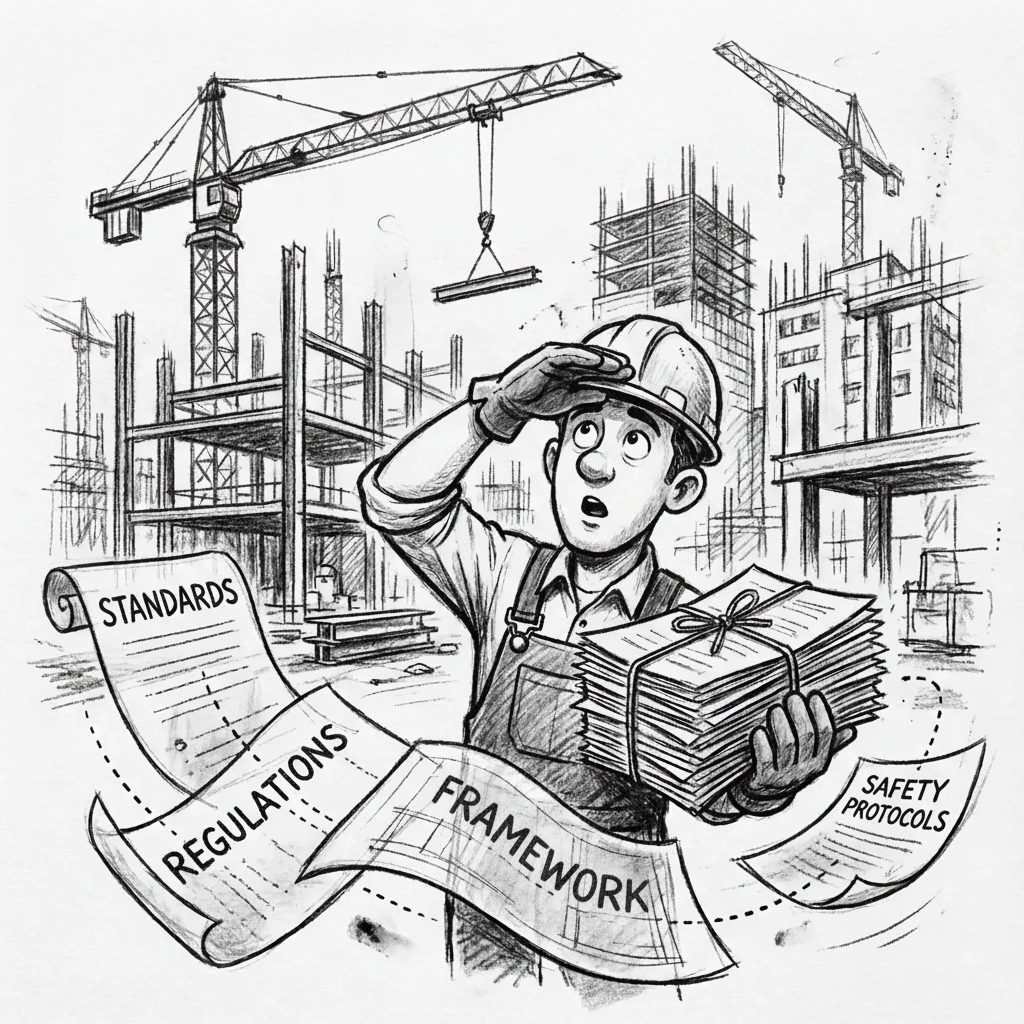
ConTech on Giga Projects [Framework]| Standards & Governance frameworks as catalysts

Post 3 — Explores the role of international standards such as the ISO 19650 and other considerations

01| Executive Overview
Across mega and giga projects, one pattern appears again and again:
Projects invest millions in digital platforms — yet struggle with rework, delays, duplicated effort, and unusable data.
Digital chaos is expensive — governance saves more money than software ever can.
The root cause is rarely the technology.
It is weak or inconsistent information governance.
Construction Technology succeeds only when it is built on a clear, enforced, and shared governance framework — and globally, ISO-19650 provides the most reliable backbone for doing exactly that.
That said, in my humble opinion, it is of paramount importance to master the standards, specifications and globally accepted best practive – however, it is even more critical to undestand and be driven by the business values of your organisation and project goals.
One must master the standards well enough to break them deliberately in service of project and business outcomes.
02| Why Governance Comes Before Technology
Most digital failures don’t happen because teams lack tools.
They happen because teams lack:
- Clear responsibility
- Structured approval paths
- Consistent data ownership
- Enforced information standards
Without governance, technology amplifies chaos instead of eliminating it.
ISO-19650 is not standard about BIM software or platforms.
It is about how the asset information is created, managed, reviewed, approved, disseminated, across the entire lifecycle of a project.
On mega projects, this distinction is critical.
03| Model of Responsibility: Who Owns What — and When
One of the most underestimated sources of digital failure is unclear responsibility. I have seen first hand, duplicate functions of similar or same function trying to push and pull data their own way. Nobody won, while for projects it was detrimental.
It usually is a bad sign (or a red flag) if projects/organisations lack defintions of:
Who authors information
Who reviews it
Who approves it
Who ultimately owns it
These typically result in:
Conflicting models
Unclear accountability
Endless review cycles
Risk transferred informally instead of contractually
ConTech oviously becomes a burden rather than a solution
A proper ISO-19650 based governance model establishes clear information roles across:
- The Owner/Client (“Appointing party”)
- The Lead Design Consultant, the General Contractor, etc. (“Lead appointed parties”)
- Sub-Consultants and Sub-Contractors (“Task teams”)
- Delivery stages
When responsibility is clear, decisions move faster and disputes drop sharply.
04| Approval Workflows: Information Is Only Valuable When It’s Trusted
Uncontrolled information is worse than no information.
Mega projects often suffer from:
- Parallel approvals
- Informal reviews outside the CDE
- “Approved” files with no traceable audit trail
- Design decisions made on outdated information
I am not a big fan of standards – especially the terminology that comes with each new standard/edition.
That said, ISO-19650-aligned approval workflows coupled with the right CDE platform ensures:
Reliable source of truth/reference
Documents that have a clear status (WIP, Draft, Approved, etc.)
Traceable approval workflows
Non-destructive, collaborative, real-time commenting and approval workflows
Tracable version control and change substantiation
We shall explore more on the verion control and non-destructive workflows on later chapters.
05| Naming Conventions: Small Discipline, Massive Impact
Here is a low-hanging fruit:
Information management 101 — “If it’s a variable, then it has no place in your document numbering protocol – it must be stored as metadata”.
Naming conventions are often treated as an administrative detail.
In reality, they are foundational to automation, reporting, and data integrity.
Without consistent naming:
- Automation Breaks
- Dashboards Lie
- Finding the latest drawing or the model requires a full-time document cotroller
- AI and data analytics related use cases become impossible
ISO-19650 by itself does not offer naming protocols, there are other standards that do this better, including local and regional adaptations of ISO 19650 — it offers metadata discipline that then can lead you to a meaningul and informed file naming and numbering protocols.
On large portfolios, consistent naming enables:
Cross-project analytics & reporting
Long-term asset data re-use, for internal and external stakeholders.
Traceable approval workflows
Scalable digital twin foundation
06| Integrating WBS, LBS, and ABS: One Language Across the Project
Governance fails when each team speaks a different “data language”
True digital maturity requires alignment between:
- WBS (how the project is delivered)
- LBS (where things are located)
- ABS (what assets actually exist)
When these structures are disconnected:
- Cost data cannot align with models (scope)
- Asset registers are rebuilt manually
- Handover becomes spreadsheet-driven
- Operations inherit unusable data
ISO-19650 provides the framework to connect these structures — but projects must implement them intentionally and deviate from standards deliberately – where needed.
Integrated coding is not optional on mega projects.
It is the only way to scale information without collapse.
07| Final Thought — The Hidden Cost of Inconsistent Governance
The most dangerous aspect of poor governance is that its cost is rarely visible upfront.
Instead, it appears as:
- Design rework
- Late discovery of coordination issues
- Crippled approval workflows
- Manual data cleansing and conditioning
- Delayed handovers
By the time issues surface, millions have already been lost. The the only viable justification or the hope is:
The power of the crowd will somehow push this to the finish line.
Strong governance framework doesn’t slow projects down —
it removes friction before it becomes expensive.
Governance Framework Is the Real Digital Backbone
Technology changes quickly. Governance endures.
Projects that succeed digitally don’t chase tools — they stabilize their information backbone first, then let technology serve it.
Stay Tuned
These series are written from a project delivery experience – not theory.

Over the last 20 years, I have helped deliver 30+ giga projects in UAE and KSA, totaling to over $20 Bn.